
The Softbank-backed company has set a price band of Rs 72 to Rs 76 per share for the maiden share sale and is expected to test the appetite for new-age loss-making companies.

'If you see another 1000-point correction, people may start panicking.'
In New York market, the dollar was little changed against major rivals yesterday as investors continued to comb through economic data and speeches from central bank officials to get a better sense of when the Federal Reserve could begin to raise interest rates.
The Reserve Bank has told the International Monetary Fund (IMF) that the objective of frequent interventions in the forex market is to curb excessive volatility, dismissing the Fund's rationale for reclassifying India's exchange rate regime. The IMF, following the Article IV consultation with the Indian authorities, reclassified the status of the exchange rate regime to "stabilised arrangement" from "floating" for period between December 2022 to October 2023. India's Executive Director at IMF K V Subramanian and Senior Advisors Sanjay Kumar Hansda and Anand Singh questioned the selection period adopted by the Fund for analysis and also reclassification of the country's exchange rate regime.

With investments by foreign investors expected to rise in the coming months, the total overseas fund flow this year could well surpass the highest ever figure recorded in 2007, when India attracted a whopping Rs 70,000 crore (Rs 700 billion).


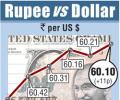
The rupee resumed higher at 60.13 per dollar as against the last closing level of 60.20 at the Interbank Foreign Exchange market, and hovered in a range of 60.07 and 60.18 per dollar before quoting at 60.08 at 1000 hours.

Equity and oil markets can breathe easy for now, as the developments in Russia are unlikely to trigger a runaway rally in crude oil prices, said analysts. India, which imports nearly 80 per cent of its crude oil requirement, has been dependent on cheap Russian oil over the past few months to keep inflation - a sore point for the equity markets - in check. For the Indian markets that are expected to remain volatile amid these developments, analysts believe, the progress of monsoon, fund flows - both foreign institutional investor (FII) and domestic - and the upcoming corporate earnings season back home remain key.

The rupee closed 2 paise lower at 60.13 on Wednesday as a sudden demand for the US currency emerged at fag-end of trade.

Rebalance your portfolio in case it has become overweight on equities vis-a-vis your strategic asset allocation.

Domestic mutual funds (MFs) have kept their faith in the Indian stock market despite multiple headwinds all through 2022-23 (FY23), with their net flows into equities crossing the Rs 1.5-trillion mark for the second consecutive financial year. MFs pumped a net Rs 1.53 trillion into equities till March 1, 2023, the Securities and Exchange Board of India (Sebi) data shows, as compared to Rs 1.72 trillion in FY22. Since FY15, MFs have been net buyers of equities, except in FY21, when they sold a net Rs 1.21 trillion.

Caution ahead of key consumer inflation data in the day also weighed.

Notwithstanding concerns about lofty valuations, smallcaps recorded their most significant monthly gain in nearly three years in November. The National Stock Exchange Nifty Smallcap 100 finished the month with a 12 per cent gain, the most since February 2021 when it rose by 12.2 per cent. After declining by 4.1 per cent in the preceding month, the Nifty Midcap 100 rose by 10.4 per cent, the most since July 2022.

Eighty per cent, or 60 of the 75 companies that made their debut on the mainboard this financial year, ended their listing day with gains.

When he didn't respond (Mr Saver has lost count of how many relationship managers he has had in the past few years!), the gentleman landed up at his doorstep and started pleading with him to open fixed deposits with the bank, observes Tamal Bandyopadhyay.

They have been on an unbroken selling streak since the Union Budget, spooked by increase in income-tax surcharge, taxes on buybacks, and lack of stimulus to prop up the economy.

The consensus among FIIs is valuation could be a concern going ahead, but that is still some way off.

An internal study by the Reserve Bank of India is understood to have found out that most of the foreign exchange inflows into India from non-resident Indians and portfolio investments are emanating from tax-haven countries.

2023 could be another volatile year for Indian equity markets, according to BofA. In a report, the brokerage pointed out that the Nifty50, at present, is trading at 20.7x against its long-term average of 18.8x one-year forward earnings of current Nifty constituents. Plus, India is trading at a 98 per cent premium to its emerging market (EM) peers against its long-term average of 45 per cent.
The Reserve Bank of India (RBI) has recommended to the finance ministry a series of measures to curb investment flows from venture funds and into real estate.

'We like certain stocks from banking, insurance, retail, hospitals and capital goods.' 'Though some of these stocks may seem expensive, they will compound well over the long term, thus justifying their current multiples.'

After declining for three consecutive quarters, the value of FPI investment in Indian equities rose 8 per cent quarter-on-quarter to $566 billion in the July-September period, according to a Morningstar report on Wednesday. A fast-changing global macroeconomic landscape, sentiments and opportunities that the Indian equity markets have to offer impacted the direction of flows by Foreign Portfolio Investors (FPIs). Through the quarter, the value of the FPI holdings in domestic equities surged by 8 per cent to $566 billion from $523 billion recorded in the previous quarter.

The Union home ministry said it has cancelled registration of 11,319 organisations that had not applied for renewal of registration under the Foreign Contribution Regulations Act by the June 30 deadline this year.

The time is ripe for a merger of eight fund houses indirectly owned and controlled by the central government, says N Sundaresha Subramanian.

Domestic mutual funds (MFs) have underpinned demand for most public floats this year, dominated by small- and mid-sized initial public offerings (IPOs). Of the 24 IPOs that have hit the market so far this financial year (2023-24, or FY24), MFs have played the role of 'anchor investors' in 20. They have subscribed to over 40 per cent, or Rs 2,850 crore, worth of shares of the Rs 6,900 crore on offer in the anchor category, according to data provided by PRIME Database, a firm that tracks primary market data.

Reliance Industries was the top gainer in the Sensex pack, soaring over 4 per cent, followed by Titan, Tata Steel, Bajaj Auto, Maruti and Dr Reddy's. Nifty advanced 89.45 points to its all-time closing peak of 17,323.60.

"It is a half-baked law, but we support it as our party favours stringent laws to defend national security," Nishikant Dubey (BJP) said initiating the debate on the Foreign Contribution (Regulation) Bill, 2010, already passed by the Rajya Sabha.

Opposition in the Lok Sabha on Friday dubbed as half baked the legislation to regulate foreign contributions in the wake of changed internal security environment.

'The market will focus on the fact that India does have strong earnings growth this year.'
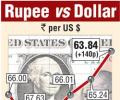
The rupee resumed higher at 64.40 a dollar from Friday's close of 65.24 and touched a low of 64.54 at the interbank foreign exchange market.

Monthly systematic investment plan (SIP) flows into India have held steady above Rs 13,000 crore in 2022-23 (FY23) in the face of markets delivering muted returns in 18 months. However, it is not a rose-tinted view when it comes to viewing new SIP registrations and the cessation of existing ones. The ratio of SIPs stopped as a percentage of fresh SIPs registered (called SIP stoppage or closure ratio in industry parlance) stood at 56 per cent in the first 11 months of FY23, compared with 41 per cent during the same period of 2021-22 (FY22).

'If such inflows materialise, what will be the effect on the rupee's value -- and therefore on exports growth, the only sustainable path to recovery?', asks Mihir S Sharma.

As Prime Minister Narendra Modi visits US, fund managers from India and abroad expect improving sentiments and impressive returns from Indian markets to help attract billions of dollars flowing into the country's asset management industry.
It is time the government woke up to the risks that uncontrolled foreign monies flowing to Indian NGOs pose to India's economic progress, social cohesion and national integrity.

Forex dealers said rupee was under pressure throughout the session as dollar gained against rivals on hopes that European Central Bank will cut its main interest rate to a record low in a bid to support the region's economic growth.

The rupee had eased by five paise to close at 60.50 against the dollar in the previous session on Thursday.

'Markets are not expensive; they are fairly priced.'

Data showed the country's wholesale price-based inflation eased to an eight-month low in January as food prices moderated, offering some relief to policymakers who have long battled to get a handle on surging prices.

Thus far in FY21, BSE, NSE have rallied 70 per cent and 71 per cent, respectively.

Forex dealers said firm local equities, signs of consistent capital inflows and sustained dollar selling by exporters also boosted the rupee sentiment.
